






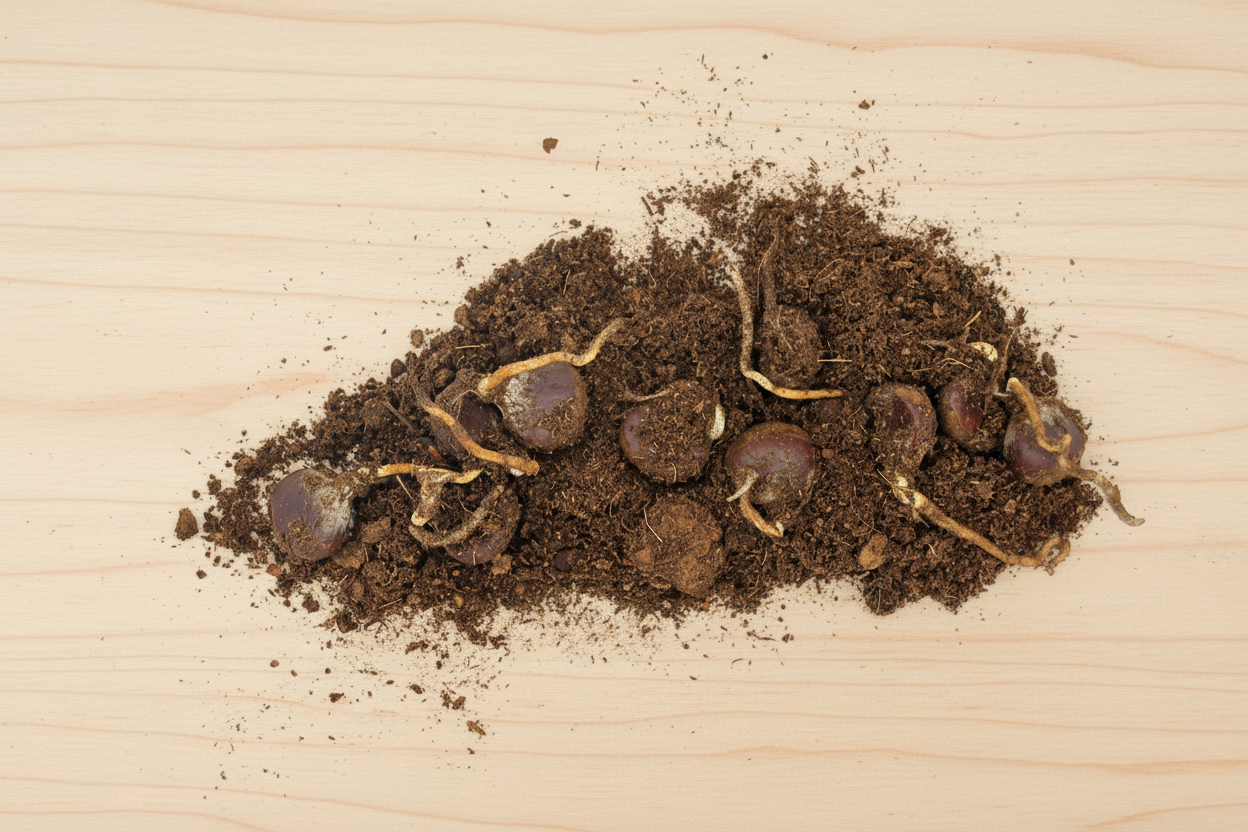
This year marks the beginning of something new for our forest, and something much bigger than our farm alone.
We recently became members of the American Chestnut Foundation and purchased our first chestnut seeds through their annual sale. It is a small start, just ten seeds, which is the current limit, but it represents a long term commitment to restoring a tree that once defined forests across the Northeast.
This effort is also part of our Forest Stewardship Plan, where introducing chestnut trees has been identified as a meaningful step toward strengthening the diversity and resilience of our land.
The History of the American Chestnut
Before the early 1900s, the American chestnut was one of the most important tree species in eastern forests. It is estimated that billions of these trees once grew from Maine to Georgia, often making up a significant portion of the forest canopy.
Chestnuts were valued not only for their size and rapid growth, but also for their reliability. They produced consistent crops of nuts that supported wildlife and rural communities alike, and their wood was naturally resistant to rot, making it ideal for building, fencing, and everyday use.
That all changed with the arrival of chestnut blight, a fungal disease introduced from overseas. Within just a few decades, the disease spread rapidly and removed mature chestnut trees from the landscape. While the root systems of many trees still survive today, they rarely grow large enough to reach maturity before the blight takes hold again.
Why Chestnut Trees Matter
Even though they are no longer a dominant part of our forests, the role chestnuts once played is still deeply relevant.
Chestnut trees are fast growing and well suited to forest systems, particularly in areas undergoing regeneration. They produce a dependable food source for wildlife, including deer, turkey, and small mammals, helping support balanced ecosystems.
From a land management perspective, they also offer potential for future use in agroforestry systems, including silvopasture. Their growth habit, productivity, and adaptability make them a valuable species to reintroduce as forests continue to evolve.
A Collective Effort to Restore a Species
The work being done to restore chestnut trees is the result of decades of research and collaboration. The American Chestnut Foundation has been leading efforts to develop blight resistant trees through careful breeding programs.
Their approach focuses on maintaining the characteristics of the original American chestnut while introducing resistance to the blight. It is a long process, but one that continues to make progress with each generation.
By becoming members and planting these seeds, we are participating, in a small but meaningful way, in that larger restoration effort.

How Chestnuts Fit Into Our Forest
On our farm, forest management is an ongoing process. We actively work within our woodland to encourage regeneration, improve species diversity, and support long term health.
Introducing chestnut trees is a natural extension of that work.
We plan to establish them within our forest stands as part of our regeneration efforts, allowing them to grow alongside other species as the forest continues to develop. Looking ahead, we also see chestnuts playing a role in our future silvopasture plans, where trees, forage, and livestock are integrated into one system.
This is not about planting a single tree. It is about shaping what our forest can become over time.
Our First Step Starting from Seed
Our first step begins with just ten seeds. We will be planting the sprouted seeds in pots to give them the best chance to establish strong roots in a controlled environment. Starting them this way allows us to monitor their growth and protect them during their most vulnerable stage.
Once they are large enough, we will transplant them into the ground within our forest stands. At that point, each tree will be protected with a cage to prevent deer browsing, which is an important step in giving them the opportunity to grow and develop.
It is a slow and intentional process, but one that gives these trees a better chance at long term success.
Looking Toward the Future
Chestnut restoration is not a short term project. It is something that unfolds over years and even decades.
The trees we are starting now are part of a much longer timeline, one that extends beyond immediate results. That is also what makes this work meaningful. It is an investment in the future of the land, in the health of the forest, and in the possibility of bringing back a species that was once foundational to this region.
We will be sharing this process as it unfolds through both blog posts and video updates. From planting and early growth to long term progress in the forest, we hope to document each stage, not only to track our own journey, but to provide insight for others interested in forest stewardship and restoration.
Restoring chestnut trees is one part of a much larger approach to caring for the land. Through active forest management, wildlife habitat support, and thoughtful planting decisions, we aim to build a system that continues to grow, adapt, and provide for years to come.





1 comment
Great! I have over 450 chestnut trees on my farm. I am down the road from Where Dr Dunstan retired and grafted the first blight free trees. Chestnut Hill Farms, Alachua Fl